Follow the Sailors
Africa’s Atlantic edge seen as a sequence of capes, sheltered harbours, desert coast, island waypoints and old maritime gateways.
Cape Town → Lüderitz → Skeleton Coast → São Tomé & Príncipe → Dakar
This is not a conventional luxury itinerary — and that is the point. Some of the best stops on Africa’s Atlantic coast have very little five-star hotel inventory. The value comes from private access, aircraft flexibility and being able to connect places that are difficult to combine commercially.
The route I would use
Days 1–3 — Cape Town and the Cape of Good Hope
Start with the geographic idea that made this route historically important: the passage around the Cape. Use one day for the Atlantic seaboard and Cape Peninsula, with a private guide who can connect the scenery to the centuries of navigation, trade and colonial expansion that followed.
Check Ellerman House on Expedia ↗
Aviation: Cape Town (CPT) → Lüderitz (LUD) is about 470 nm. A suitable light/midsize jet is typically around 1½–1¾ hours block time. Lüderitz has an 1,830 m main runway, so aircraft choice must be performance-checked rather than assumed.
Day 4 — Lüderitz, Namibia
Lüderitz works best as a one-night or even a long day stop. The harbour was known to Portuguese navigators centuries before the modern town, and the surrounding desert creates one of the starkest port settings in Africa. Add Kolmanskop if time allows.
Aviation: Lüderitz (LUD) → Walvis Bay (WVB) is about 225 nm; allow roughly 50–65 minutes depending on aircraft and routing.
Days 5–7 — Skeleton Coast via Walvis Bay
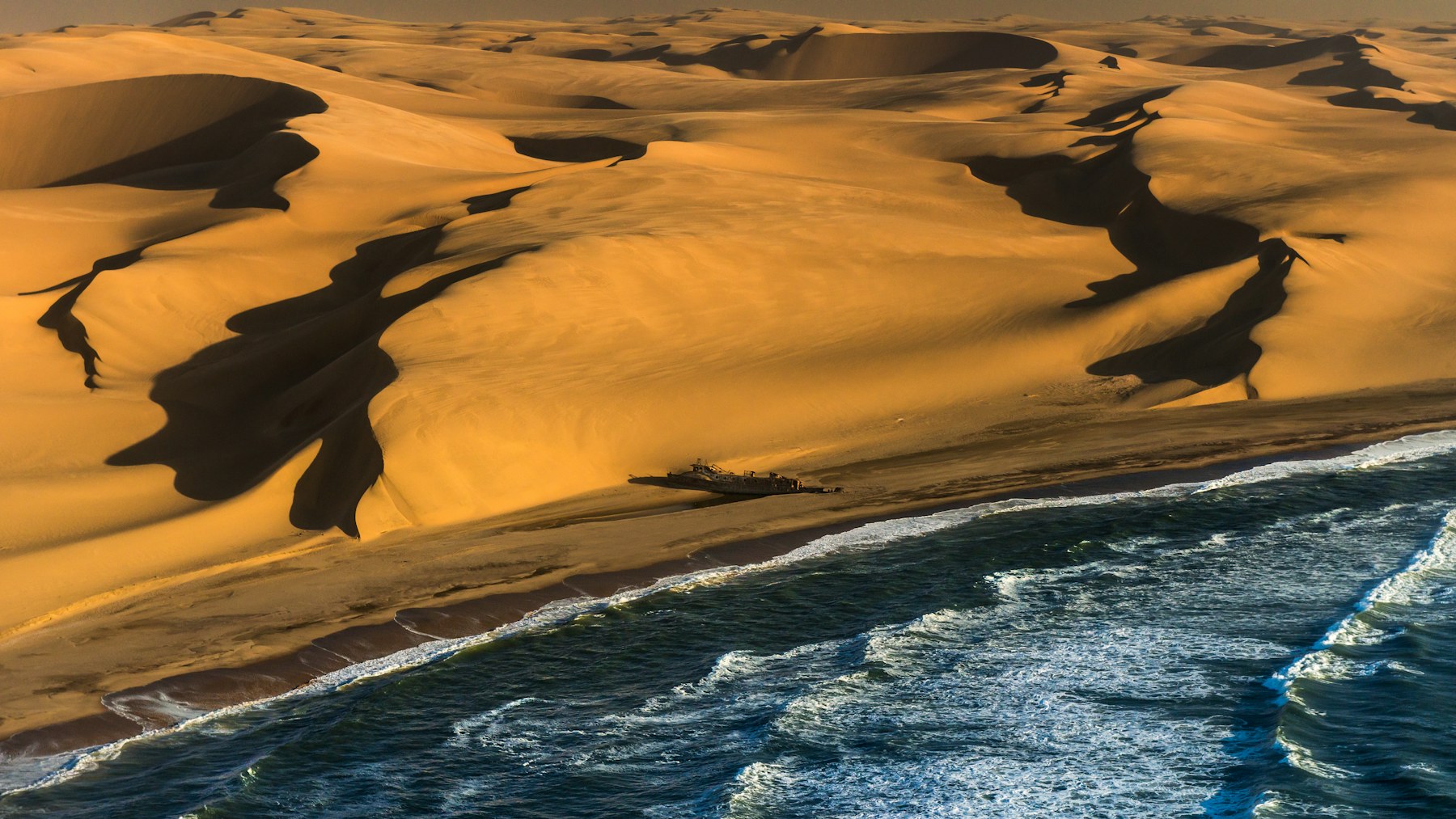
Walvis Bay is the practical aviation gateway; the real destination is farther north. The Skeleton Coast gives the itinerary its strongest visual identity: fog, dunes, wrecks, seal colonies and almost no conventional settlement. From Walvis Bay, continue by light aircraft to a remote coastal lodge.
Check Shipwreck Lodge on Expedia ↗
Aviation: Use Walvis Bay (WVB) as the jet gateway, then transfer north by the lodge’s approved light-aircraft operation. Do not choose a business jet around the remote strip.
Days 8–10 — São Tomé & Príncipe
Jump from desert coast to equatorial island. São Tomé and Príncipe sat on Atlantic routes linking Africa, Europe and the Americas, but today the islands feel far removed from major circuits. I would use São Tomé mainly as the gateway and continue to Príncipe for the actual stay.
Check Sundy Praia on Expedia ↗

Aviation: WVB → São Tomé (TMS) is about 1,480 nm; plan roughly 3¾–4¼ hours in a suitable midsize jet. TMS has a 2,220 m runway. TMS → Príncipe (PCP) is only about 90 nm and is better treated as a 30–40 minute regional/light-aircraft sector; PCP’s runway is about 1,750 m.
Days 11–13 — Dakar, Senegal
Finish in a city that faces directly into the Atlantic and has long served as a major West African maritime gateway. Use one day for Dakar itself and one for Gorée Island with a specialist guide, treating the history carefully rather than as a photo stop.
Check Terrou-Bi on Expedia ↗
Aviation: Return PCP → TMS first, then fly São Tomé (TMS) → Dakar/Blaise Diagne (DSS), about 1,650 nm. A suitable midsize jet is typically around 4¼–4¾ hours block time. DSS has a 3,500 m runway and is the clean long-haul exit for the route.
Why I changed Walvis Bay into a gateway rather than the destination
Walvis Bay matters operationally, but the stronger private-travel experience is the Skeleton Coast north of it. A jet can bring you efficiently to Walvis Bay; a smaller aircraft then completes the mission into the remote lodge network. That is a better use of private aviation than adding another city hotel night simply because the runway is convenient.
Flight plan at a glance
| Sector | Practical routing | Indicative block time |
|---|---|---|
| Cape Town → Lüderitz | CPT → LUD · light/midsize jet | ~1½–1¾ hr |
| Lüderitz → Walvis Bay | LUD → WVB · light jet/turboprop | ~50–65 min |
| Walvis Bay → São Tomé | WVB → TMS · midsize jet | ~3¾–4¼ hr |
| São Tomé → Príncipe | TMS → PCP · regional/light aircraft | ~30–40 min |
| São Tomé → Dakar | TMS → DSS · midsize jet | ~4¼–4¾ hr |
Times are planning ranges. Winds, permits, ATC, crew duty, fuel requirements and aircraft performance can materially change the final movement.
The historical thread
The journey intentionally spans different eras rather than claiming one continuous sailing route. Portuguese navigators rounded southern Africa and used Atlantic waypoints; Lüderitz and Walvis Bay later developed under very different colonial histories; São Tomé became deeply connected to plantation and Atlantic trade systems; Dakar grew into a major regional port. The common thread is the coastline itself and the way maritime access shaped settlement and power.
Aircraft strategy
A super-midsize or heavy jet may make sense for the long international legs, especially Namibia to the Gulf of Guinea and onward to Senegal. The Skeleton Coast and Príncipe portions are different: expect smaller approved aircraft for the final sectors. One aircraft for the entire route is possible in theory only if it can use every airport — but it is usually not the best operational or economic choice.
Who this route is for
Repeat visitors to Africa, sailors and yacht owners, history-focused travellers, photographers and clients who value remote geography over resort density. It is much more distinctive than a classic safari-and-beach circuit, but it requires more tolerance for uneven hotel standards between the headline luxury stops.
Related planning
Final routing, airport selection and access depend on permits, weather, runway limits, aircraft range, crew duty and current lodge operations.